Stone Buying Guide
How and when to actually buy your stone in Melbourne, and how not to get caught out.
Introduction
Choosing the stone is the fun part. Buying it is where people get tripped up because the process is unfamiliar, the suppliers are scattered, and both the money and risk sit with you rather than your builder. This guide walks you through when to buy, how stone is sold and priced, how deposits and holds work, and the one big risk you need to understand before anyone touches a slab.
One thing to be clear about up front: this guide is about buying the stone, meaning the slabs themselves. Cutting, edging, cutouts and installing your benchtop is a separate job done by a stonemason, usually engaged by your builder, and priced separately. The good news in that split is real: because you buy the stone directly and the builder engages the mason, your builder is not adding a margin to the stone materials.
When to buy
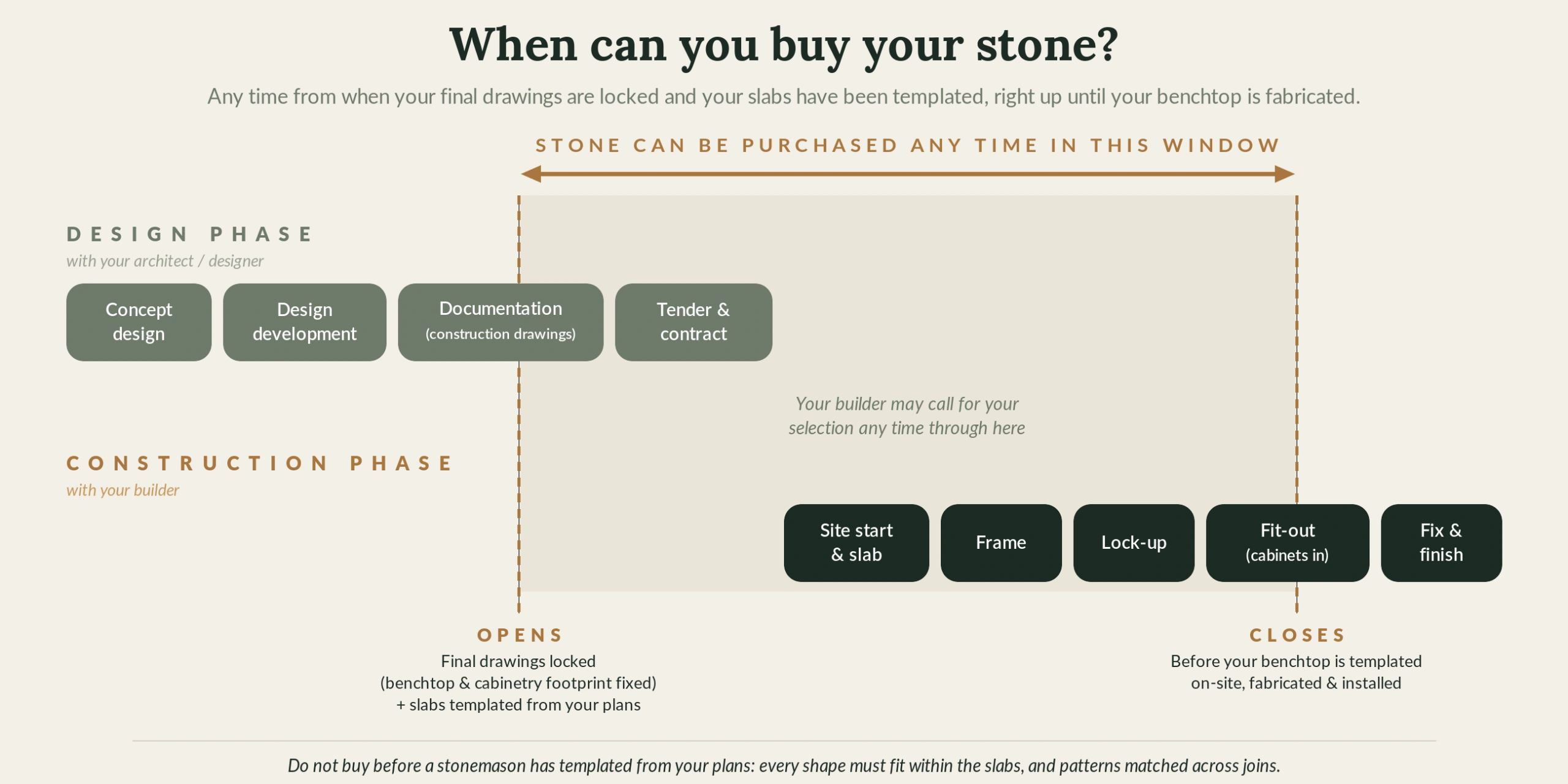
You can buy your stone any time you have final drawings where the surfaces and the cabinetry footprint are locked and are no longer shifting. That moment can arrive while you are still in documentation with your architect, or once construction is underway and your builder tells you it is time to make a selection, or anywhere in between.
There is one non-negotiable prerequisite. A stonemason must have done templating from your plans so you know how many slabs your job actually needs. Every shape has to tetris into the slabs, and patterns (e.g. veins) need to be matched across joins, so slab count is not something you can eyeball. Do not purchase any stone until this templating is done. And be ready for a shock: you'll be buying many more square metres than the surface area in your drawings.
Worth knowing: there are two different templating steps, and people confuse them. The first is templating from your plans, which tells you how many slabs to buy and is the one that must happen before you purchase. The second is on-site templating, where the mason measures your actual installed cabinets to fabricate the benchtop. That happens later, once cabinetry is in. The buying window in the diagram opens at the first and closes before the second.
How early should you buy? Time is your biggest advantage
The single thing that most works in your favour is time. The earlier in the process you buy, the more choice you have, and some people buy up to a year before they need the stone purely to widen their options.
Here is why timing changes what is possible. Stock sitting in a warehouse that you can touch and feel is available almost immediately, but if you have left your run late, you may have to choose from whatever happens to be on the floor, and only where there are enough matching slabs for your job. Leave it late enough and the decision effectively makes itself, which is not always in your favour.
With more time up your sleeve, you have real options:
Revisit the same suppliers every couple of months to see what new slabs have landed.
Tell them exactly what you are chasing and ask them to keep an eye out.
Ask what they have "on the water", meaning stone already shipped and arriving in the next couple of months.
At the extreme, and this is genuinely rare, ask a supplier to have their buying team, including the inspectors they employ in the country of origin, look out for something specific for you.
The catch with having time is the temptation to decide from photos. Nothing compares to seeing a slab in person, and choosing from images carries a real risk of disappointment, which stings all the more once you have put down a deposit.
So use time to widen your search, but make the final call in person. And when you do find the right stone, expect to move quickly: a slab you love is genuinely one of a kind, and hesitation is how it ends up in someone else's kitchen.
Blocks, slabs and square metres
Natural stone is sold in units that catch first-time buyers out, so here is the shorthand.
A block is the large piece cut straight from the quarry. It is sliced into slabs, which are the individual sheets you actually buy. A typical slab is roughly 3-3.4m by 1.8-2m, around 5.5-6.5 square metres, usually in a 20mm thickness (30mm exists but is less common). Consecutive slabs cut from the same block mirror each other, which is called bookmatching, and it matters a lot for waterfall ends and long runs where you want the veins to flow. If your job needs the pattern to continue across pieces, you want consecutive slabs from the same block, so reserve them together. Reassuringly, consecutive slabs from a block do not cost more, so if there is any chance you will want a matched run, secure them.
Stone is priced per square metre, and in the trade those prices are quoted ex-GST, so add 10% for the real number. You buy whole slabs, not the exact area of your benchtop, and you will always need more square metres than your finished surface, because of offcuts, sink and cooktop cutouts, a breakage allowance, and vein matching. This is exactly why the plan templating matters: it converts your benchtop into a realistic slab count rather than a hopeful one.
Shopping around, and why it is harder than it looks
Melbourne's natural stone suppliers are spread across the outer suburbs, because warehousing slabs is expensive and yards go where the space is cheap. Only some open on weekends, and the ones that make shopping easy tend to be the inner-city showrooms, in places like Richmond, where the overhead is built into the final price. That alone makes comparing stone a genuine time sink.
It gets harder, because stock is always moving. Suppliers have slabs coming in and going out constantly, and the number of slabs of any given stone varies week to week. That means online browsing and showrooming are largely unhelpful: you are buying what is physically in the yard on the day, not a catalogue item you can order to spec. If you find the right slabs, they are the right slabs now, not necessarily next month.
Your architect or interior designer may be a real help through this, and some are excellent at it. Many are not. Procurement and project management often are not in their wheelhouse, and it is not what they trained for. Be aware too that some receive commissions or incentives from particular suppliers when their clients buy there, and others will help but charge a hefty hourly rate including travel time to drive between yards. None of that makes them bad at their actual job of design; it just means sourcing may not be the best use of them, or of your money.
This is where Stone Search does its work: finding close matches to the stone you have already fallen for, across the yards that do not advertise, without the showroom markup and without you taking time off work to drive to industrial estates.
Ask for a sample
Some suppliers keep small samples of the stones they stock. Be clear on the limits up front: plenty of suppliers do not offer samples at all, and even at those that do, only some slabs will have one available. So this is a bonus when you can get it, not something to count on. But if a sample exists for a stone you are considering, get it. It earns its keep twice.
First, colour matching. A physical sample lets your architect or interior designer match cabinetry, wall colours and flooring against the actual stone rather than a photo, and stone reads very differently under your lighting than under warehouse fluorescents.
Second, and most valuable, stain testing. Staining is the biggest everyday risk with natural stone, and a sample is yours to experiment on in a way no supplier will let you near a slab. Leave olive oil, red wine or coffee sitting on it and see what soaks in, what wipes away, and what a mark actually looks like. You can also check how it handles acids like lemon juice. A few days with a sample tells you more about how a stone will live in your kitchen than anything on the label.
Deposits, holds and payment
The money side has more variation than people expect, so read the terms before you commit anything.
Holds. Most suppliers will hold stone for you for one to four weeks while you decide, before they require a commitment and a deposit. This holding period is where Stone Search does its best work for you, using the time to confirm the stone, compare options and negotiate.
Deposits. Expect to pay a deposit of 20% to 50%. The terms differ widely: some deposits are refundable, some are non-refundable, and some are refundable but come with a restocking fee if you change your mind. Always get which one it is in writing.
The residual. Most suppliers require full payment of the balance when they release the stone. However, some demand the residual after three to six months in storage.
Storage. Most suppliers will store your stone for you for twelve months or longer, which gives you room if your build timeline moves.
Delivery
Getting the stone from the supplier to the stonemason your builder has chosen costs money, but it is usually one of the smaller numbers in the job. As a rough guide, expect somewhere around $150 to $500 ex-GST depending on the quantity of stone and the distance involved.
The big one: who handles the stone, and who wears the risk
This is the part most buyers do not see coming, so it gets its own section.
Many custom builders do not want to touch the stone themselves. They would rather you pay for it and have the stonemason collect it or receive the delivery directly. The reason is risk. Stone can crack in transport, or in the hands of the stonemason during fabrication, and that is exactly where the arguments start. When a slab is damaged, it is often unclear whether the cause was bad workmanship by the mason or a flaw in the stone from the supplier, and builders would rather stay out of that dispute entirely.
You need to go in aware that a dispute between the stonemason and the stone supplier is always possible if something is damaged. In the worst case you can end up as the arbiter between them, and potentially the one who has to foot the bill. This risk is hard to avoid completely. What you can do is reduce it: photograph your specific slabs when you select them and again when they are delivered, keep the paperwork, and get the responsibility for damage in transit and handling agreed in writing before anything moves.
Two pieces of good news balance this out. First, because the stone materials are bought by you rather than run through the builder, the builder is not adding margin to them. Second, the builder is still the one engaging the stonemason, so managing that fabrication relationship is not something you have to take on yourself.
A simple sequence
To pull it together, a sensible order of events looks like this:
Lock your final drawings, with the benchtop and cabinetry footprint fixed.
Have a stonemason template from those plans to get your slab count.
Identify the stone you love.
Shop and match across yards, or let Stone Search do it.
View and approve the actual slabs in person.
Place a hold and get a quote, or let Stone Search negotiate on your behalf.
Review terms and conditions, or let Stone Search do this, and then pay a deposit.
Send your architect and builder photos and any sample of the stone you've purchased.
When the builder is ready, contact the supplier to arrange residual payment and delivery to the builder's chosen stonemason.
Where Stone Search fits
Buying stone rewards knowing the process and having someone work the yards on your behalf. Stone Search finds the same stone or an honest match at a Melbourne supplier without the showroom overhead. We use the holding period to confirm the stone and negotiate, and we help you navigate deposits, holds and delivery so you are not learning it all for the first time under time pressure. You only pay if you go ahead with a stone we've found that beats your quote.
We can also attend yard viewings with you, so you have someone in your corner reading the slabs and the terms on the day. Viewings are charged at an hourly rate whether or not you make a selection; on larger projects we usually offset that against our final fee, and on smaller jobs it's charged in addition to the fee.
Already been quoted, or about to start shopping? Send us the details and let's see if we can do better.
Andrew Mote · andrew@stonesearch.com.au · 0411 649 989 · www.stonesearch.com.au
This guide is general information to help you buy well, not legal, financial or contractual advice. Supplier terms vary, so always confirm deposits, refunds, payment timing and damage responsibility in writing with your specific supplier before you commit.